
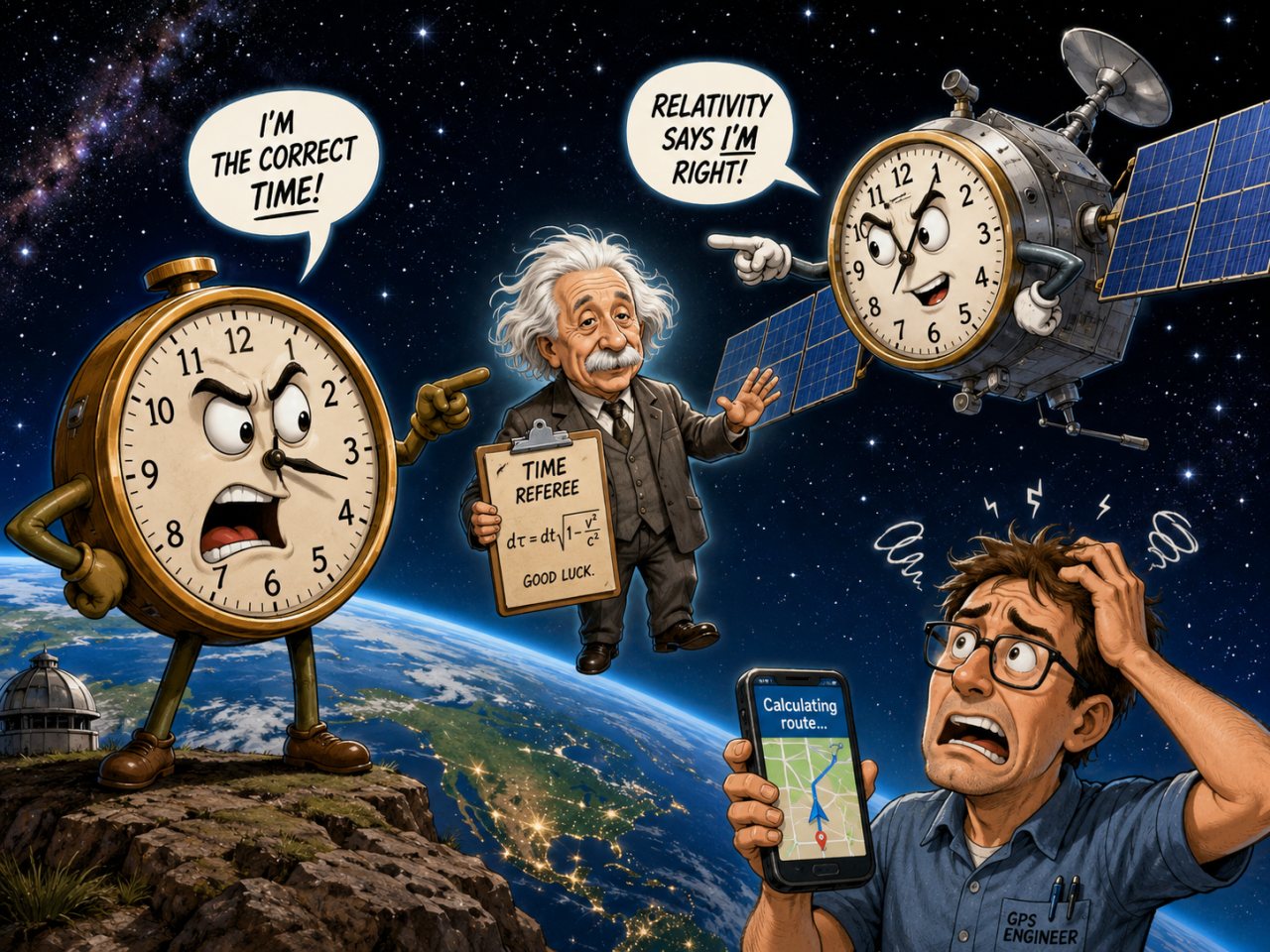
Do you remember paper maps?
Not many people do.
These days we’re all dependent on our smartphones and car-dashboard Global Positioning Systems (GPS). We wait obediently for the little, endlessly customizable voice to tell us to “Turn left” or “Take the second exit at the roundabout.”
But have you ever thought about how GPS actually works?
You are probably at least vaguely aware that “there are some satellites up there that do stuff.”
Turns out, the “stuff” is considerably more fascinating.
And more scandalous.
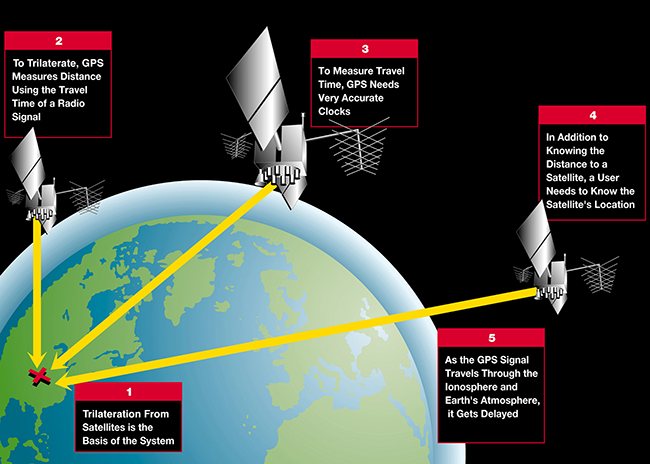
More than 30 GPS satellites orbit Earth roughly 20,200 kilometers (12,550 miles) above the surface. Each carries extremely accurate atomic clocks and continuously broadcasts radio signals containing its location and the exact time the signal was transmitted.
Those radio signals travel at the speed of light.
Your GPS receiver measures how long the signals took to arrive and uses that information to calculate its distance from the satellites. By comparing signals from at least four satellites, it can work out your latitude, longitude, altitude, and correct for the fact that the clock in your phone is nowhere near as accurate as the atomic clocks orbiting overhead.
This process is called trilateration.
And it all depends on measuring time with ridiculous precision.
Which creates a slight problem.
Time itself refuses to cooperate.
The clocks aboard GPS satellites do not tick at exactly the same rate as clocks on Earth's surface.
Why?
Because Einstein had to get involved.
The satellites are moving rapidly, which makes their clocks run slightly slower according to special relativity.
But they're also much farther from Earth, where gravity is weaker, which makes their clocks run faster according to general relativity.
The two effects partially cancel each other out.
But gravity wins.
Altogether, GPS satellite clocks would run about 38 microseconds per day faster than comparable clocks on Earth if the difference weren't accounted for.
Thirty-eight microseconds sounds like the sort of discrepancy you could safely file under “Who cares?”
Unfortunately, light can travel about 300 meters in a single microsecond.
So tiny timing errors become enormous positioning errors very quickly. Without relativistic corrections, GPS navigation would err by kilometers/miles.
Which means every time your phone confidently announces:
“You have arrived at your destination.”
you have atomic clocks, satellites, radio waves, orbital mechanics, and Albert Einstein's theories of relativity quietly working together behind the scenes.
So the next time your GPS tells you to turn right where there is absolutely no right turn...
Don't blame relativity.
Einstein did his part.
It's probably just bad map data. Or your GPS deciding that a goat trail behind a Dollar General is clearly a major thoroughfare.
The Real Story
GPS works by turning time into distance.
Each GPS satellite carries extremely accurate atomic clocks and broadcasts a signal that tells receivers where the satellite was and exactly when the signal was sent. Because radio waves travel at essentially the speed of light, a GPS receiver can compare the transmission time with the arrival time and calculate how far away the satellite is. With signals from at least four satellites, the receiver can solve for its three-dimensional position and correct for the error in its own much less accurate clock.
That system works only if everybody agrees on what time it is.
Unfortunately, Einstein had some notes.
According to special relativity, a moving clock runs more slowly relative to a clock that is moving less quickly. GPS satellites race around Earth at roughly 14,000 kilometers per hour, so their motion causes their clocks to lose about 7 microseconds per day compared with clocks on Earth.
But general relativity pushes in the opposite direction.
Gravity also affects the passage of time. Clocks deeper in a gravitational field run more slowly than clocks where gravity is weaker. GPS satellites orbit about 20,200 kilometers, or 12,550 miles, above Earth, where Earth's gravitational pull is weaker than it is at the surface. That causes their clocks to run about 45 microseconds per day faster than comparable clocks on Earth.
So GPS engineers get the following accounting problem:
- Motion: about 7 microseconds per day slower.
- Weaker gravity: about 45 microseconds per day faster.
The two effects partially cancel, leaving the satellite clocks running about 38 microseconds per day faster overall relative to clocks on Earth's surface.
Thirty-eight millionths of a second per day does not sound particularly alarming.
For GPS, it is.
Light travels almost 300 meters in one microsecond. A timing error of just a few microseconds therefore corresponds to hundreds or thousands of meters of ranging error. NIST notes that if relativistic effects were not accounted for, GPS positioning errors would accumulate by roughly 10 kilometers (6.2 miles) per day.
GPS was therefore designed with relativity built into its timekeeping and navigation calculations. Satellite clock frequencies and receiver algorithms account for the fact that clocks in orbit and clocks on Earth do not naturally tick at exactly the same rate. Relativity is not an optional scientific refinement added for physicists who enjoy making equations longer. It is part of what makes the system work.
There are other corrections too. GPS receivers must deal with delays as signals pass through the ionosphere and troposphere, orbital uncertainties, satellite clock errors, and other sources of measurement error. But relativity presents a particularly spectacular example of fundamental physics quietly hiding inside ordinary technology.
Every time your phone locates you on a map, estimates your arrival time, or tells you that you have somehow missed the same exit for the third time, it is relying on clocks orbiting thousands of miles overhead whose tick rates have been adjusted because speed and gravity really do change the passage of time.
Einstein died decades before anyone had GPS in a car.
He still somehow ended up riding shotgun as the navigator.
Sources
-
Putting Einstein to the Test
National Institute of Standards and Technology. Putting Einstein to the Test. NIST.
Why this source matters: Primary accessible source for the GPS relativity numbers. Supports the approximately 7 microseconds/day slowing from special relativity, approximately 45 microseconds/day speeding from weaker gravity, and the net 38 microseconds/day faster satellite-clock rate.
-
Space Segment
GPS.gov. Space Segment. U.S. Government.
Why this source matters: Supports the operational GPS constellation, approximately 20,200 km (12,550 mile) orbital altitude, twice-daily orbits, and availability of at least four satellites from virtually anywhere on Earth.
-
Satellite Navigation - GPS - How It Works
Federal Aviation Administration. Satellite Navigation - GPS - How It Works. FAA.
Why this source matters: Supports GPS ranging from signal travel time, satellite atomic clocks, use of at least four satellites, solving for latitude/longitude/altitude/time, and atmospheric propagation-delay corrections.
-
The Global Positioning System, Relativity, and Extraterrestrial Navigation
Ashby, N. (2009). The global positioning system, relativity, and extraterrestrial navigation. Proceedings IAU Symposium No. 261.
Why this source matters: Technical source supporting the necessity of relativistic corrections in GPS navigation and time transfer.