

It started as it usually does.
I see a headline. I have questions. And I go searching for answers.
In this case, a headline screamed, "Scientists may have found a starless galaxy!"
And my immediate response was, "WHAT? How can a galaxy be starless?"
Followed almost immediately by, "And for that matter, what actually DEFINES a galaxy in the first place?"
You see, I'd always imagined galaxies as enormous collections of stars, like our very own Milky Way or the neighboring Andromeda Galaxy.
Stars are kind of their thing.
Even Google's AI Overview confidently informed me that galaxies contain billions to trillions of stars.
Which was not particularly helpful when I was trying to understand a galaxy that might contain ZERO.
So imagine my surprise when astronomers announced that they'd found an object containing roughly two billion Suns' worth of hydrogen, but apparently couldn't find any stars.
Two billion solar masses of gas, and not a single star willing to come forward?
Did somebody forget to turn on the lights?
Had the entire stellar population gone into hiding?
Or had astronomers discovered a cosmic warehouse full of star-making ingredients where nobody had ever bothered to start production?
And if there really aren't any stars, why are we calling this thing a galaxy?
Surely there must be some minimum requirements for galaxy membership. A gravitationally bound community? A stellar population? A completed application form?
This smelled like a Science Scandal.
And the deeper I looked, the more I realized that the seemingly simple question, "What is a galaxy?" has a surprisingly complicated answer.
The Real Story
Astronomers have identified a mysterious object called AGC 322753 that contains an enormous quantity of hydrogen gas but has no detectable population of stars.
The object was detected independently by two radio astronomy surveys, ALFALFA, conducted with the Arecibo radio telescope in Puerto Rico, and FASHI, conducted with China's Five-hundred-meter Aperture Spherical Radio Telescope (FAST).
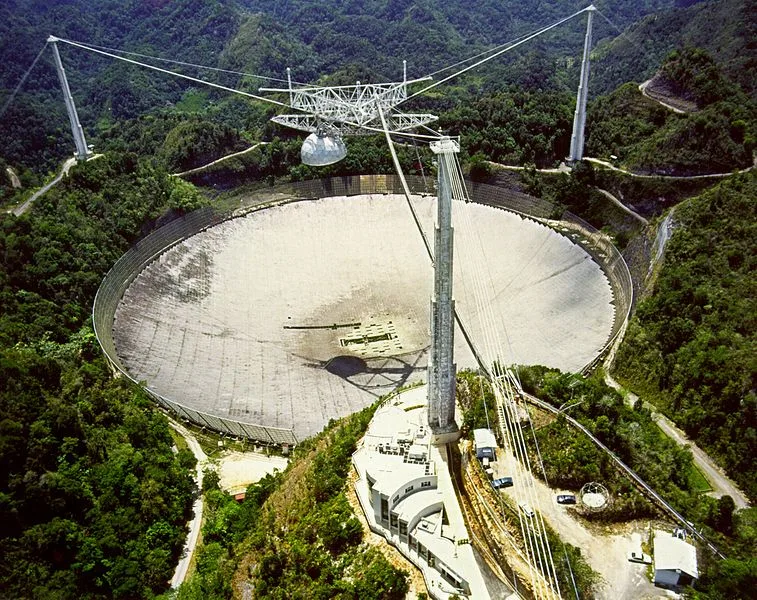
Both surveys detected neutral hydrogen gas at essentially the same recessional velocity, with similar spectral characteristics. The researchers concluded that they were observing the same astronomical object rather than an artificial radio signal or instrumental error.
And this is no insignificant puff of gas.
The estimated neutral hydrogen mass is approximately two billion solar masses. A solar mass is simply a unit of mass equal to that of our Sun, so the hydrogen alone has approximately as much mass as two billion Suns.
But that doesn't mean the object contains two billion stars.
In fact, astronomers haven't identified any stars associated with it.
So how can something without detectable stars possibly be considered a galaxy?
What actually defines a galaxy?
A galaxy is generally understood as an enormous, gravitationally bound system containing stars, gas, dust, and usually substantial amounts of dark matter.
Gravitationally bound means that the system's components are held together by their mutual gravitational attraction rather than simply passing one another as unrelated objects. They can move within the system without immediately escaping into intergalactic space.
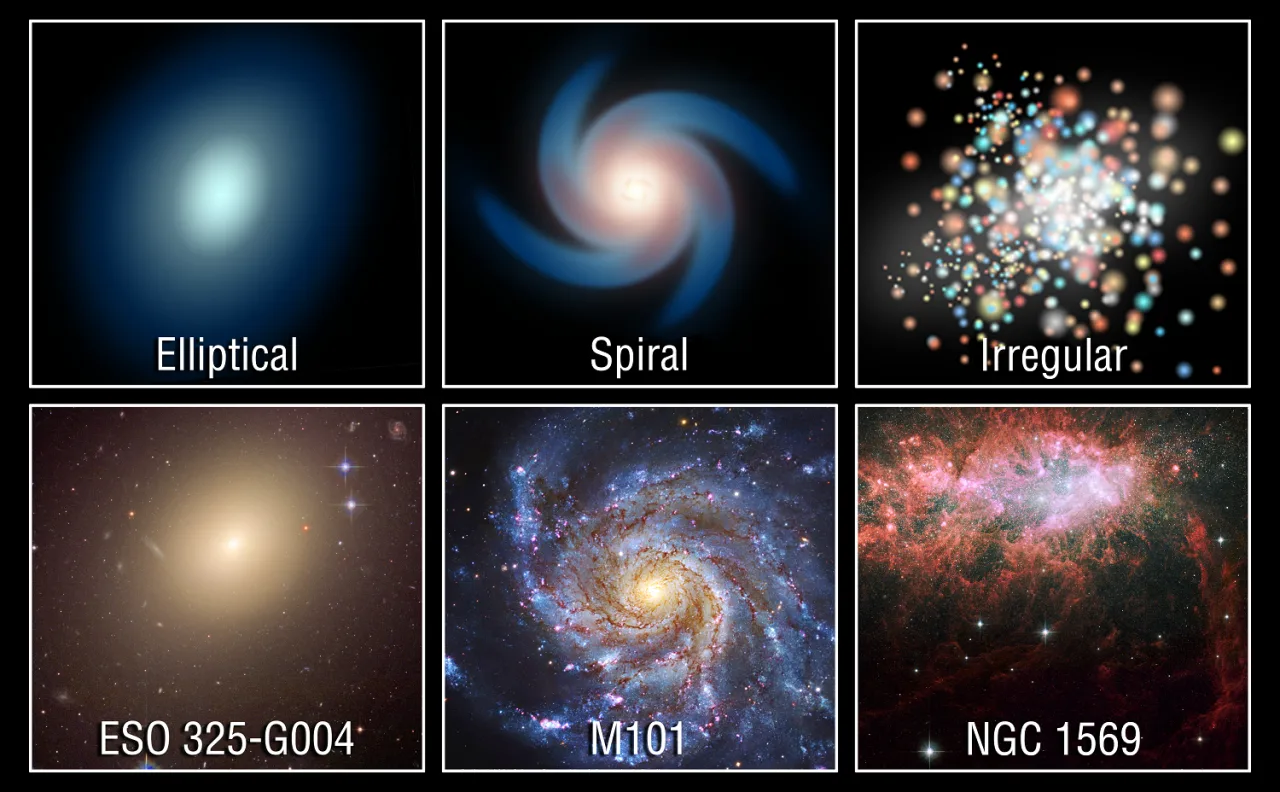
Our Milky Way is a galaxy containing roughly 100 billion stars. The neighboring Andromeda Galaxy contains an even larger stellar population. But galaxies aren't required to have billions of stars. Some extremely faint dwarf galaxies contain only thousands.
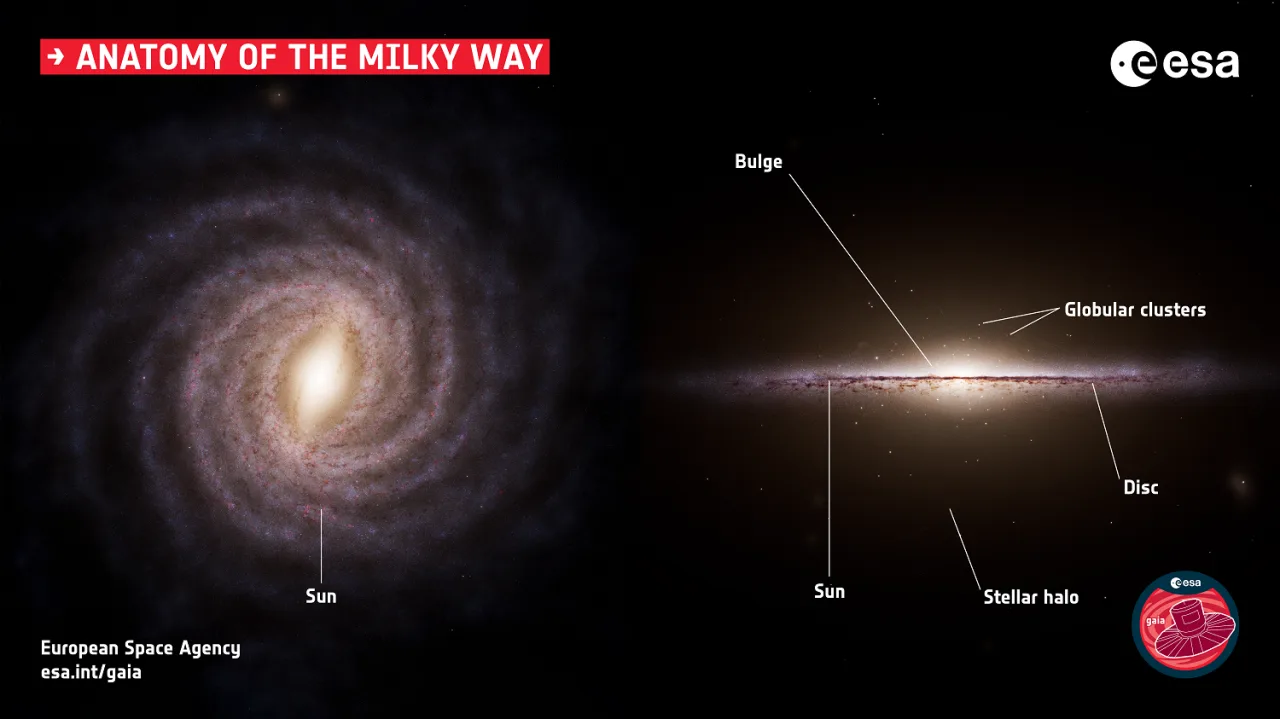
There is also no universally agreed minimum number of stars required for an object to qualify as a galaxy.
In fact, astronomers have debated how to distinguish the smallest galaxies from large star clusters, since both can be collections of stars held together by gravity.
One important distinction involves dark matter, a form of matter that does not emit or reflect detectable light but whose gravitational effects help explain the motions of stars and gas.
In the prevailing cosmological model, galaxies generally occupy extended concentrations of dark matter called dark matter halos. Their gravity helps hold the system together, including material located far beyond its visible stars.
We'll investigate dark matter and the evidence for its existence much more thoroughly in a future Science Scandal.
For now, the important point is that a galaxy is more than a collection of stars. Its overall gravitational structure matters, too.
But this creates another problem. If an object contains gas and dark matter without any stars, should astronomers still call it a galaxy?
That question remains open. Some researchers reserve the term galaxy for systems containing stars, while others investigate whether gravitationally bound, starless systems within dark matter halos should qualify.
Which brings us back to AGC 322753.
How do astronomers find something they can't see?
Neutral atomic hydrogen produces a characteristic radio emission at a wavelength of approximately 21 centimeters.
This emission comes from a tiny energy change associated with the magnetic properties of the hydrogen atom's proton and electron.
Radio telescopes can detect that signal even when the gas is too diffuse to produce an obvious image in visible light.
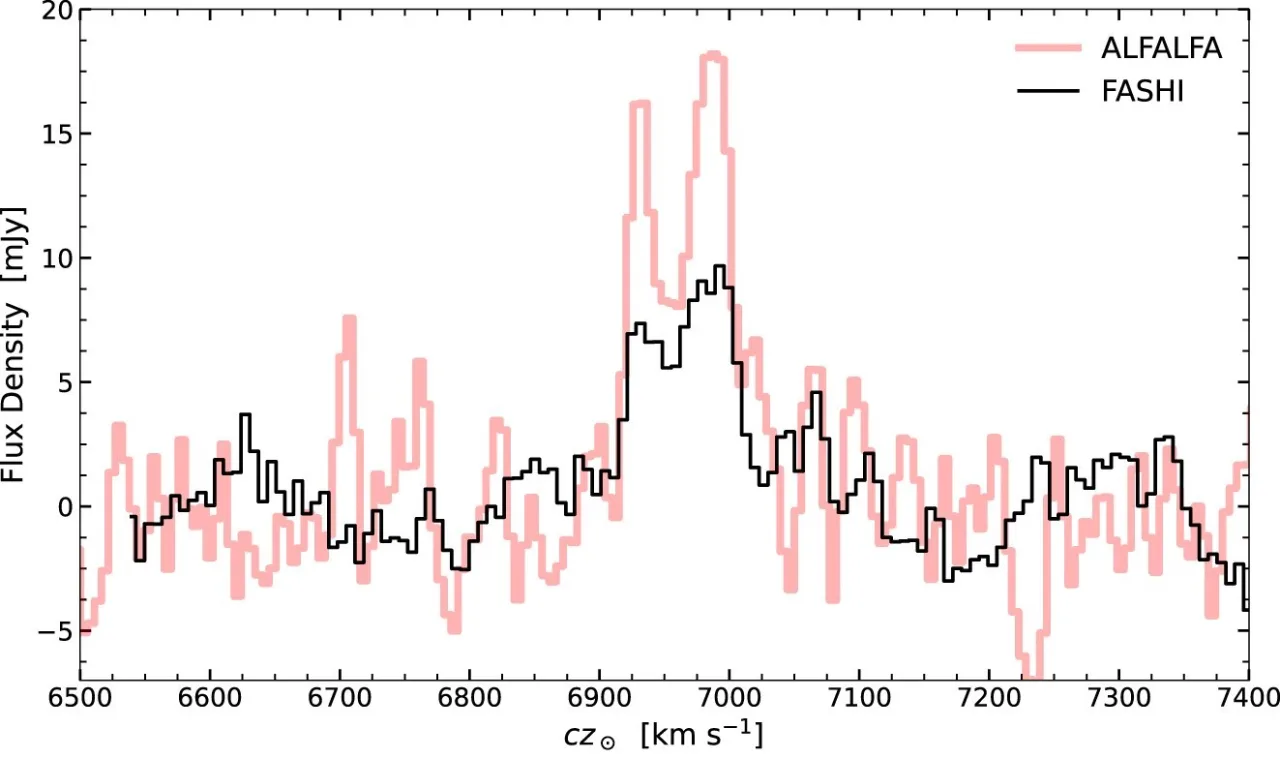
The signal also contains information about the gas's motion. When gas moves toward or away from us, its radio emission shifts slightly in frequency through the Doppler effect.
For AGC 322753, both surveys detected a double-peaked hydrogen spectral profile, consistent with what astronomers might expect from a rotating disk of gas.
That suggests the hydrogen could be part of an organized system rather than an entirely shapeless cloud.
However, the observations don't yet establish exactly how the gas is distributed or whether it forms a gravitationally bound galaxy.
Where are all the stars?
Researchers searched deep optical images from the DESI Legacy Imaging Surveys and several other astronomical surveys for a visible counterpart to the radio detection.
They found none that could convincingly be associated with AGC 322753.
The deepest optical observations reached a surface brightness of approximately 27.5 magnitudes per square arcsecond.
Surface brightness describes how much light an extended object produces across a particular area of the sky. An extremely diffuse collection of stars can have such low surface brightness that it blends into the background, even if the stars collectively contain substantial mass.
Using the imaging limits and simulated faint galaxies, the researchers estimated that AGC 322753 could contain up to approximately 50 million solar masses in stars without being detected in the available optical observations.
That means its neutral hydrogen mass is at least roughly 40 times greater than the estimated upper limit on its stellar mass.
But notice the important distinction.
Not detecting stars does not prove that no stars exist.
AGC 322753 could contain an extraordinarily faint stellar population that current observations simply cannot reveal.
A galaxy that forgot to make stars?
There's another reason this object has attracted attention.
In the standard picture of galaxy formation, gas accumulates within gravitational structures, and under suitable conditions, some of that gas can cool, become sufficiently dense, and eventually form stars.
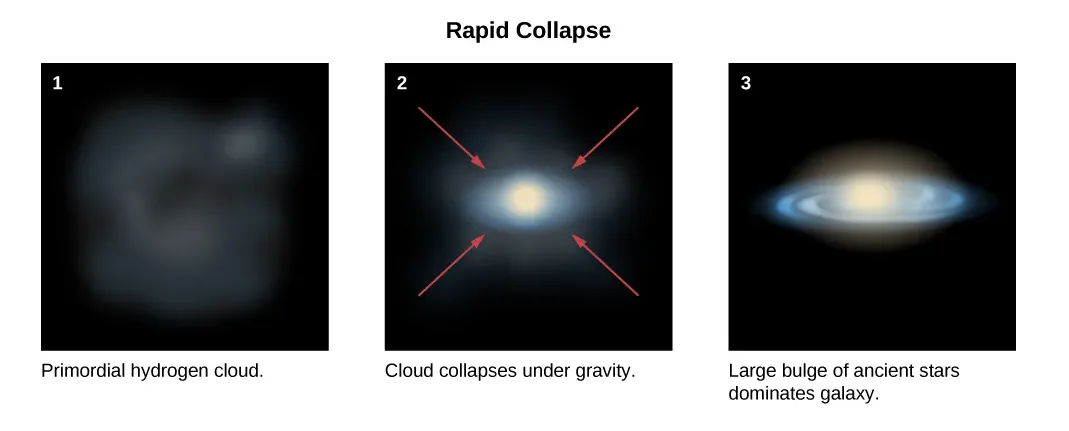
But collecting hydrogen doesn't guarantee that stars will form. Gas must reach appropriate physical conditions, and various processes can prevent or suppress star formation.
Astronomers have proposed that some dark matter halos might retain gas while forming few stars, or perhaps none at all.
The problem is that AGC 322753 appears to contain considerably more neutral hydrogen than current simulations predict for completely starless systems.
That makes its identity especially puzzling.
Could it be an unusually gas-rich galaxy whose stars are simply too faint to detect?
Could it be a rare example of a gravitationally bound system that has formed almost no stars?
Or could it represent some other gas structure, such as material displaced by interactions between galaxies?
The researchers consider a cloud of tidally displaced gas less likely because of the object's apparent isolation and spectral properties, but they cannot yet rule it out.
More observations are needed.
Deeper optical imaging might uncover an extremely faint stellar population. Higher-resolution radio observations could map how the hydrogen is distributed and moving, helping astronomers determine whether it behaves like a rotating, gravitationally supported system.
Until then, AGC 322753 remains a dark-galaxy candidate, not a confirmed starless galaxy.
And that's the fascinating lesson behind this discovery.
What we can see is not necessarily everything that exists. Even the classification of an astronomical object can depend on observations that reveal only part of its physical structure.
Astronomers have found an enormous supply of hydrogen.
They've searched for the stars.
And so far, nobody has managed to locate the stellar department.
The investigation remains open.
Sources
-
AGC 322753: A dark galaxy candidate detected by ALFALFA and FASHI
Monaci, M., Forbes, D. A., Couch, W. J., & Brodie, J. P. (2026). AGC 322753: A dark galaxy candidate detected by ALFALFA and FASHI. Monthly Notices of the Royal Astronomical Society, 552(4), Article stag1874.
Why this source matters: The original peer-reviewed investigation of AGC 322753, documenting the independent radio detections, enormous neutral hydrogen reservoir, lack of a detected optical counterpart, and evidence supporting its classification as a dark-galaxy candidate.
-
“Galaxy,” Defined
Willman, B., & Strader, J. (2012). “Galaxy,” defined. The Astronomical Journal, 144(3), Article 76.
Why this source matters: Examines the difficulty of distinguishing galaxies from other gravitationally bound stellar systems and proposes a physically motivated definition. The authors explicitly identify completely starless, gas-containing systems as an unresolved classification question.
-
Spectral Lines (Chapter 7 of Essential Radio Astronomy)
Condon, J. J., & Ransom, S. M. (2016). Spectral lines. In Essential radio astronomy (pp. 233–276). Princeton University Press.
Why this source matters: Explains the characteristic 21-centimeter radio emission of neutral hydrogen and how radio spectral lines reveal the presence, motion, and distribution of gas in galaxies.
-
Galaxies
National Aeronautics and Space Administration. (n.d.). Galaxies.
Why this source matters: Provides an accessible overview of galaxies as gravitationally bound systems containing stars, gas, and dust, and explains the enormous variation in galaxy size, structure, and stellar populations.