
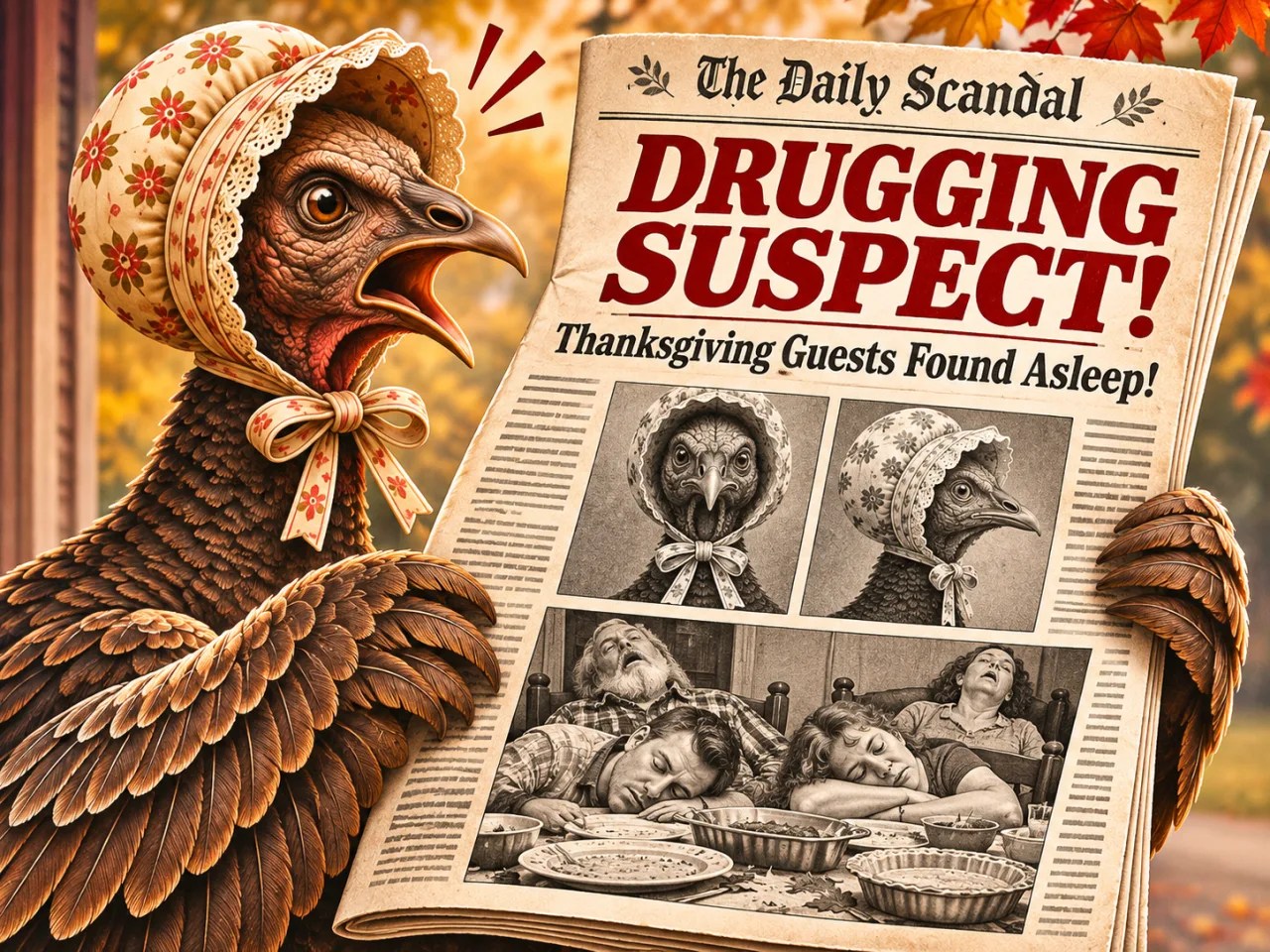
Gabbie Mae Gobbler has been accused of sedating millions of Americans every November.
The allegation usually arrives after Thanksgiving dinner, often from a witness reclining on the couch amid the wreckage of stuffing, casseroles, rolls, pie, and at least one regrettable third helping.
The alleged weapon is tryptophan.
Gabbie Mae, a self-possessed wild turkey hen who has spent years minding her own business in rural Georgia, was understandably outraged when she opened the newspaper and discovered her photograph beneath the headline DRUGGING SUSPECT!
"My very FIRST appearance in Science Scandal, and I have to spend it defending myself? I haven't even had a chance to refuse an interview yet!"
She had expected a proper introduction. Some tea and scones. Perhaps a little recognition for her independence, her impeccable observation skills, or her excellent taste in treetop accommodations.
Instead, she was apparently responsible for putting half the country to sleep.
Gabbie Mae examined the allegations, reviewed the Thanksgiving menu, and looked pointedly at the witness sprawled across the couch.
"Now, explain to me why y'all are so certain the turkey did anything at all."
Turkey does contain tryptophan, an essential amino acid that helps the body build proteins and can be used to make serotonin and melatonin. That much is real. But the stronger claim that Thanksgiving turkey contains some extraordinary sedative power that single-handedly knocks out the dinner guests is much shakier than its annual reputation suggests.
Because tryptophan is not unique to turkey. Chicken contains it. Eggs contain it. Cheese contains it. Fish, nuts, and seeds contain it. Yet somehow, the annual accusations always seem to stop at the carving platter.
So if people really do get sleepy after Thanksgiving dinner, the better question is not whether tryptophan exists. The better question is whether turkey deserves to take the blame for what is usually a massive mixed meal eaten in generous quantities, often alongside alcohol, at a time of day when many people were already headed toward a post-lunch slowdown.
The Real Story
1. What Is Tryptophan, and Why Is Turkey Getting the Blame?
Turkey really does contain tryptophan, an essential amino acid that the human body cannot manufacture and must obtain from food.
Like other amino acids, tryptophan is used to build proteins. But it also has another important job: serving as a starting material for the production of serotonin, a neurotransmitter involved in mood, sleep, and other physiological functions. Serotonin, in turn, can be converted into melatonin, the hormone that helps regulate the body's sleep-wake cycle.
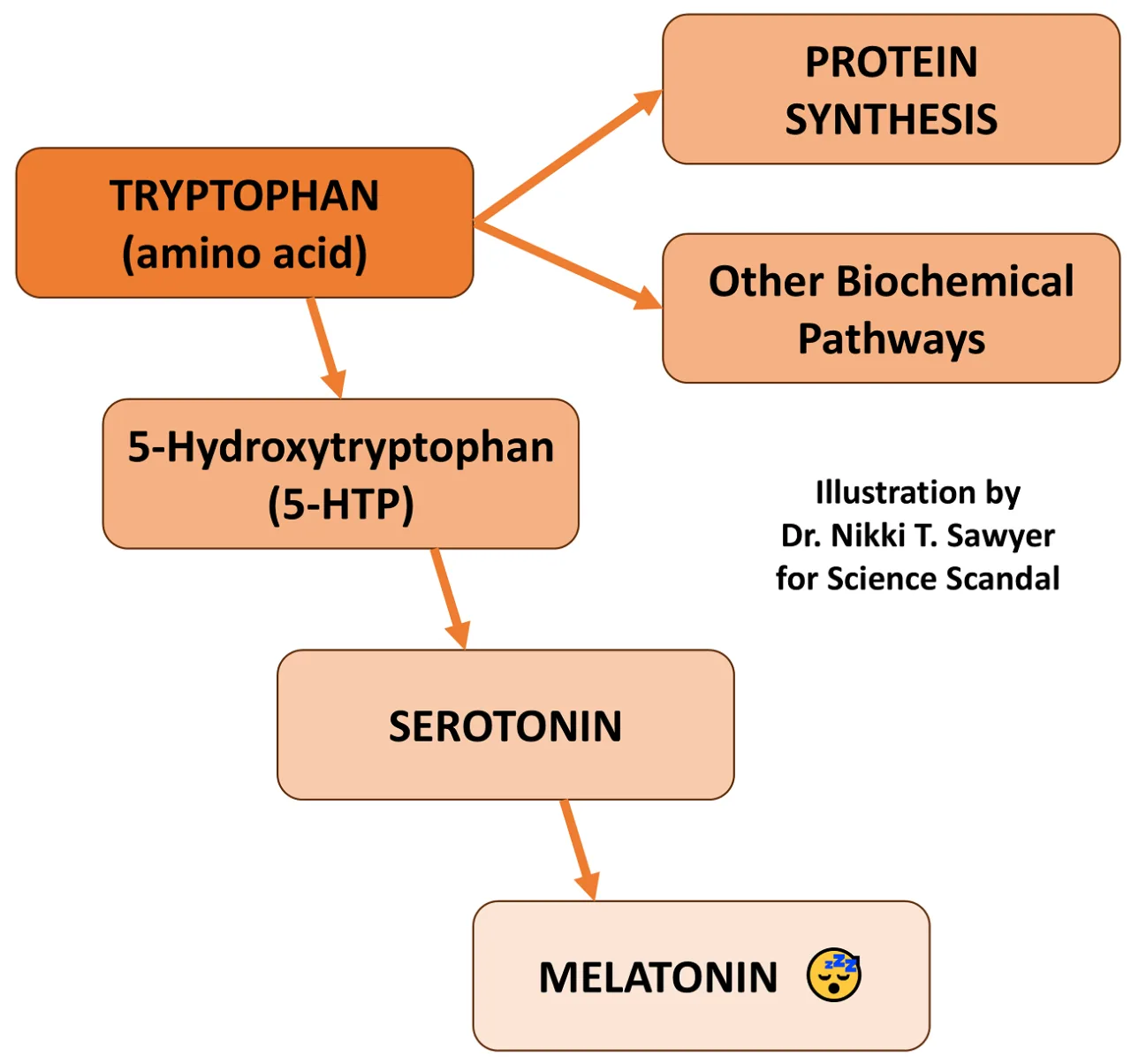
That biochemical connection is where turkey's questionable reputation begins.
However, tryptophan is hardly exclusive to turkey. Chicken, beef, fish, eggs, dairy products, nuts, and seeds all contain it. Turkey does not have some extraordinary concentration that makes it uniquely capable of putting people to sleep.
And although tryptophan is necessary for producing serotonin and melatonin, eating more tryptophan does not automatically mean producing more of either. Those processes are regulated by several factors, including the availability of other amino acids and the body's internal biological clock.
2. Why Doesn't Eating Turkey Flood the Brain With Sleep-Inducing Chemicals?
Before tryptophan can contribute to serotonin production in the brain, it must cross the blood-brain barrier, a protective boundary that carefully controls which substances can enter brain tissue from the bloodstream.
Here's where things get interesting.
Tryptophan shares a transport system with several other large neutral amino acids, including leucine, isoleucine, valine, phenylalanine, and tyrosine. Because these amino acids compete for transport into the brain, the amount of tryptophan available depends partly on its concentration relative to those competitors.
And turkey, being a protein-rich food, supplies plenty of competing amino acids along with its tryptophan.
Carbohydrates complicate the picture further. A carbohydrate-rich meal can stimulate insulin release, encouraging muscle tissue to take up several of the competing amino acids. Under some conditions, this increases the ratio of tryptophan to its competitors in the blood, potentially making more tryptophan available to the brain.
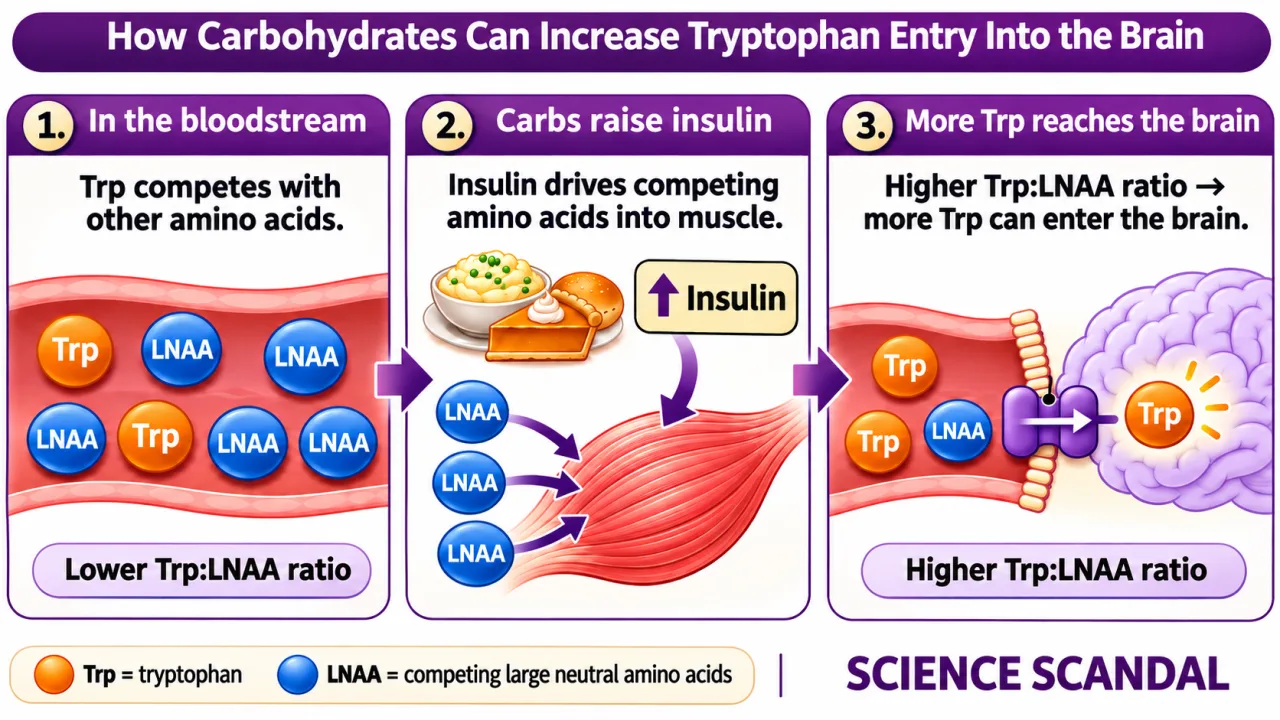
In a small human study published in 2003, researchers compared carbohydrate-rich and protein-rich breakfasts and found substantial differences in these circulating amino-acid ratios.
But the researchers were measuring blood chemistry, not Thanksgiving naps.
And a carbohydrate-rich breakfast containing very little protein is not the same thing as a holiday feast containing turkey, stuffing, potatoes, casseroles, and desserts. Adding carbohydrates to a mixed meal does not guarantee that the brain will suddenly begin manufacturing enough serotonin or melatonin to send everyone to sleep.
The biochemical pathway exists. The claim that Thanksgiving turkey reliably exploits it to sedate dinner guests is another matter entirely.
There's also the question of timing. Some Thanksgiving guests are already getting sleepy while much of their dinner is still being digested. Turning turkey protein into absorbed tryptophan, transporting it into the brain, and converting it through several regulated biochemical reactions is not an instantaneous process. The turkey-as-sleeping-pill explanation has more than a little trouble accounting for that timeline.
3. So What Really Causes the Thanksgiving Food Coma?
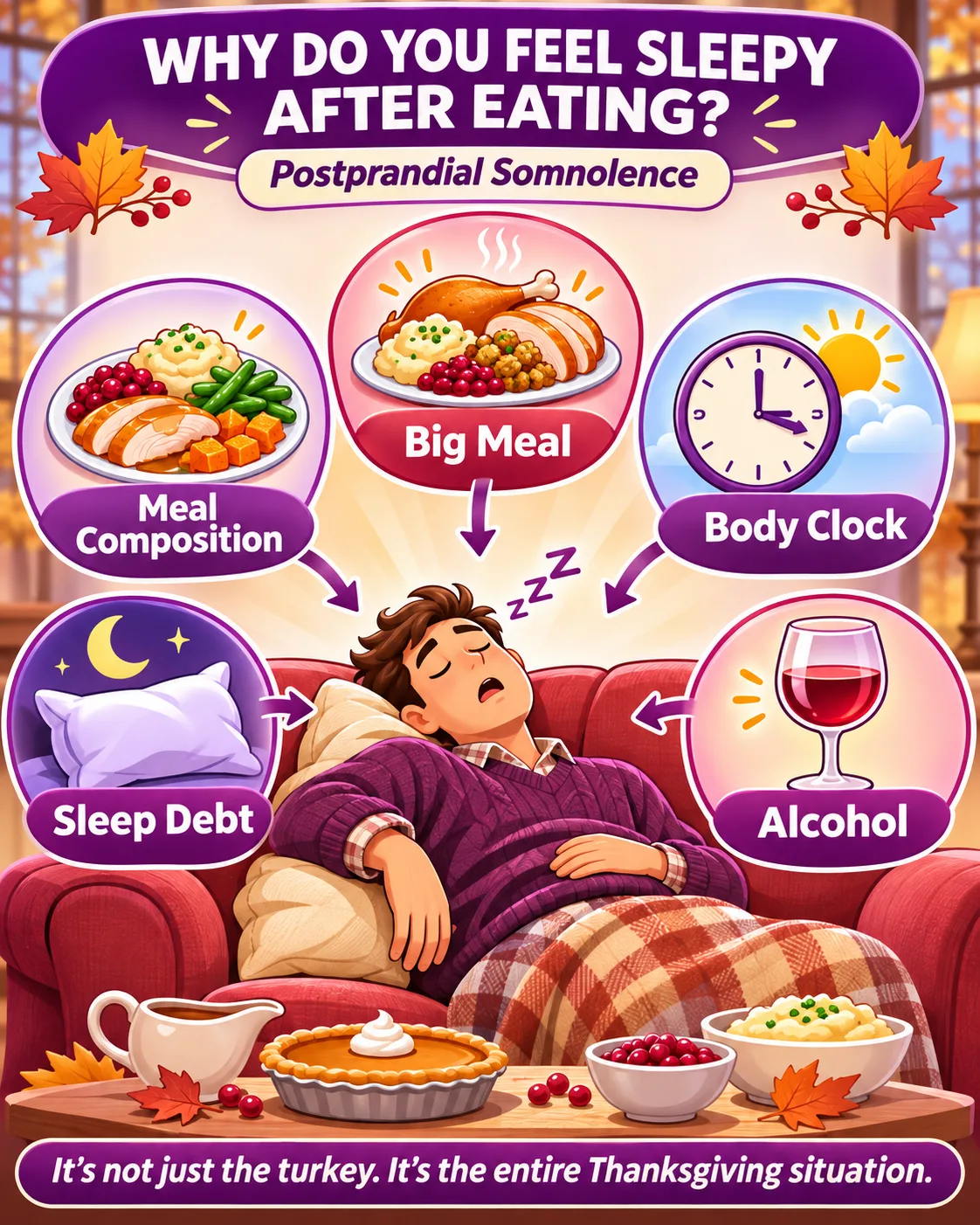
The familiar wave of sleepiness after a large meal is called postprandial somnolence. It is a real phenomenon, but its causes are more complicated than one particular amino acid.
Meal size and composition can influence how alert people feel afterward. Researchers have found that carbohydrate-rich and fat-rich meals can affect different measures of fatigue, although the results depend on what is measured and the experimental conditions.
In another small experiment, participants fell asleep more quickly after eating a solid meal than after drinking an equivalent volume of water. Interestingly, changing the proportions of fat and carbohydrate did not produce significant differences in how quickly they fell asleep.
These findings suggest that the effects of eating on sleepiness cannot be reduced to a simple rule about one nutrient.
There are also factors that have nothing to do with the turkey.
Alcohol, if consumed with dinner, can increase drowsiness. Poor sleep the previous night can make fatigue more noticeable. And many Thanksgiving meals occur during the afternoon, when the body's circadian rhythms naturally produce a period of reduced alertness.
Combine those influences with a particularly large meal, and an afternoon on the couch becomes considerably less mysterious.
None of this means that tryptophan is irrelevant to sleep physiology. It is an essential precursor in pathways that help regulate sleep. But having a biochemical role in sleep is not the same thing as making one ordinary food a powerful sedative.
So the evidence does not support blaming Thanksgiving sleepiness specifically on turkey.
Gabbie Mae Gobbler appears to have been singled out for possessing an amino acid found throughout the grocery store.
Meanwhile, the third helping has yet to explain itself.
Sources
-
Effects of normal meals rich in carbohydrates or proteins on plasma tryptophan and tyrosine ratios
Wurtman, R. J., Wurtman, J. J., Regan, M. M., McDermott, J. M., Tsay, R. H., & Breu, J. J. (2003). Effects of normal meals rich in carbohydrates or proteins on plasma tryptophan and tyrosine ratios. The American Journal of Clinical Nutrition, 77(1), 128–132.
Why this source matters: This human study demonstrates how carbohydrate-rich and protein-rich meals produce different circulating ratios of tryptophan to the other amino acids that compete with it for entry into the brain.
-
Post-prandial changes in measures of fatigue: Effect of a mixed or a pure carbohydrate or pure fat meal
Cunliffe, A., Obeid, O. A., & Powell-Tuck, J. (1997). Post-prandial changes in measures of fatigue: Effect of a mixed or a pure carbohydrate or pure fat meal. European Journal of Clinical Nutrition, 51(12), 831–838.
Why this source matters: This experiment examined how meals of different compositions affected subjective fatigue, reaction time, and other measures of alertness, showing that post-meal fatigue involves more than a single nutrient.
-
Meal composition and its effect on postprandial sleepiness
Orr, W. C., Shadid, G., Harnish, M. J., & Elsenbruch, S. (1997). Meal composition and its effect on postprandial sleepiness. Physiology & Behavior, 62(4), 709–712.
Why this source matters: This study measured how quickly participants fell asleep after eating and found that consuming a solid meal increased sleepiness compared with drinking water, without significant differences between the tested macronutrient compositions.
-
Sleep and Diet: Mounting Evidence of a Cyclical Relationship
Zuraikat, F. M., Wood, R. A., Barragán, R., & St-Onge, M.-P. (2021). Sleep and diet: Mounting evidence of a cyclical relationship. Annual Review of Nutrition, 41, 309–332.
Why this source matters: This scientific review explains the relationships between dietary tryptophan, brain amino-acid transport, serotonin and melatonin synthesis, and the broader interactions between diet and sleep.
-
The turkey coma — fact or fiction?
Shmerling, R. H. (2026, April 24). The turkey coma — fact or fiction? Harvard Health Publishing.
Why this source matters: Harvard Health explains why turkey's ordinary tryptophan content does not make it uniquely sedating and discusses other possible contributors to sleepiness following a Thanksgiving meal.
-
Be Alert for Key Factors that Promote Fatigue!
National Institute for Occupational Safety and Health. (Last Reviewed 2020, March 31). Be alert for key factors that promote fatigue! Centers for Disease Control and Prevention.
Why this source matters: This CDC resource describes the natural afternoon decline in alertness and explains how circadian timing and insufficient sleep contribute to fatigue independently of food intake.