

Breaking News! The Jurassic has submitted a new candidate for the least dignified fossil-related headline: Squid Butt! 🤣
Wyoteuthis linsterorum is a newly described species of extinct squid-like cephalopod found in Wyoming. These ancient animals are called belemnites, and they differed from modern squid in a few key ways.
One of the major differences is that, unlike modern squid, belemnites had a hard internal shell that included a large calcium-carbonate “guard” called a rostrum. Located at the rear of the animal, the rostrum has been proposed to act partly as a counterweight, helping balance and stabilize the animal in the water.
And yes, the two newly described fossils from Wyoming have an exceptionally thick, barrel-shaped rostrum.
Baby’s got back!
A badonkadonk!
Junk in the trunk!
Or just...
squid butt.
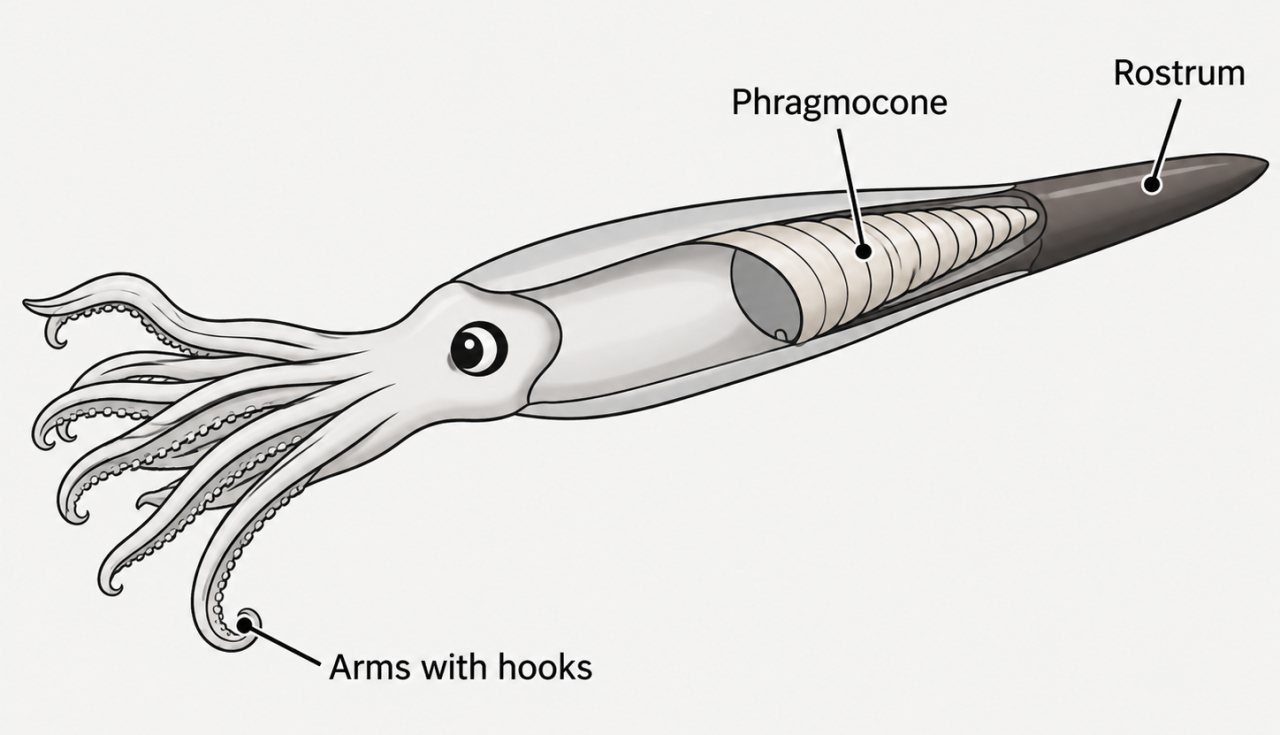
There were other differences too. Modern squid typically have eight arms plus two specialized longer tentacles. Belemnites instead had ten roughly equal-length arms equipped with numerous small, sharp, curved hooks for grasping prey.
And belemnites disappeared about 66 million years ago, around the same time as the mass extinction that wiped out the non-avian dinosaurs.
But Wyoteuthis linsterorum has the thickest belemnite rostrum known so far.
Paleontology has therefore gifted us an exceptionally broad fossilized object and an exceptionally dignified anatomical term for it: rostrum.
Wyoming paleontologists, however, apparently looked at these fossils and said: Squid butt.
And yes.
The nickname will be staying.
The Real Story
Belemnites are extinct marine cephalopods related to modern squid, cuttlefish, and octopuses. They lived throughout much of the Mesozoic Era and were especially common during the Jurassic and Cretaceous periods. Unlike modern squid, belemnites had a substantial internal shell that included a hard, usually bullet-shaped structure at the rear called the rostrum. Because the rostrum was mineralized, it fossilized much more readily than most of the animal’s soft body.
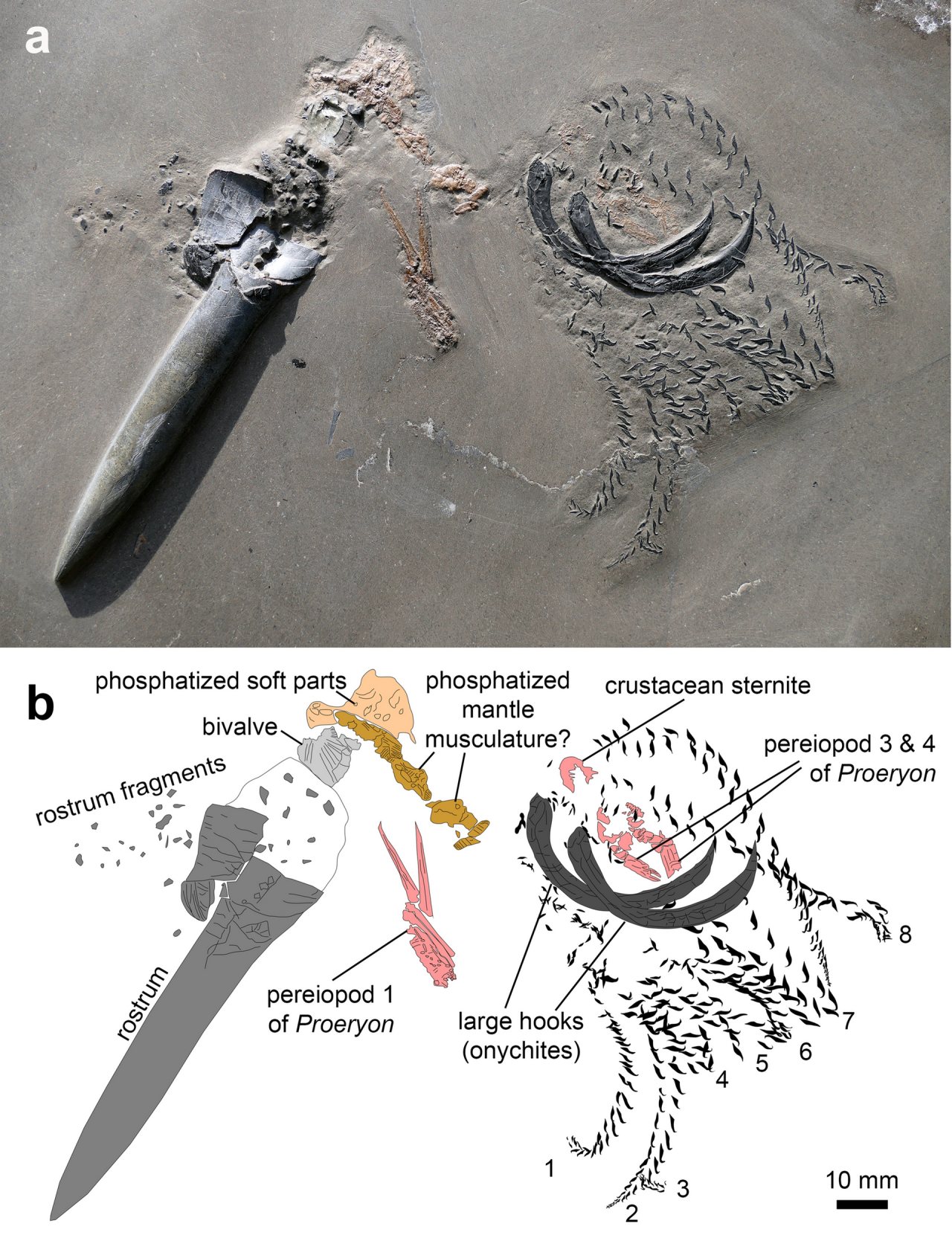
That means when paleontologists find a belemnite “squid butt,” they are not finding an actual fossilized backside. They are finding the hard internal rostrum that once sat inside the rear portion of the animal.
And the two rostra assigned to the newly named species Wyoteuthis linsterorum are extraordinarily weird.
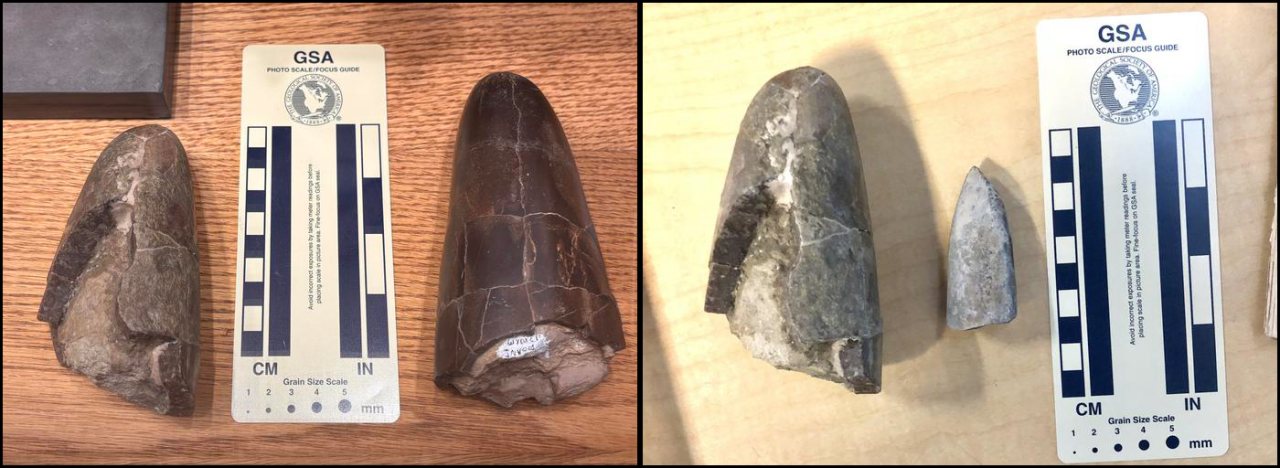
Both were recovered from the Redwater Shale Member of Wyoming’s Sundance Formation, deposited during the Oxfordian stage of the Late Jurassic, roughly 160 million years ago. Only two specimens are currently known. One was found near Thermopolis, Wyoming, and the second near Hyattville.
Most belemnite rostra from this part of Wyoming are long and relatively narrow, commonly around 5–10 centimeters long and only about 1–2 centimeters wide. The new species is dramatically broader. Its barrel-shaped rostrum is roughly 10 centimeters long but reaches about 6 centimeters across. The researchers describe these as the thickest belemnite rostra known so far.
In other words:
The fossil is not especially long.
It is just profoundly committed to width.
Researchers used CT scanning, including higher-resolution micro-CT imaging on one specimen, to examine structures hidden inside the rock without cutting the fossils apart. Those internal features, together with the overall shape of the rostrum and other anatomical details, allowed the team to place Wyoteuthis within an ancient family of belemnites called the Megateuthididae.
And that is where the evolutionary part of the scandal gets interesting.
Megateuthidids flourished earlier in the Jurassic but most of their lineages disappeared by the Middle Jurassic. Until now, this particular branch was not known from the Upper Jurassic of North America. Wyoteuthis therefore appears to represent a rare relict lineage: a surviving offshoot of a group that had largely vanished millions of years earlier. The authors interpret its presence in Wyoming as evidence that this lineage survived in a previously unrecognized refuge in the northeastern Pacific.
So the discovery is not merely:
Look at this unusually wide squid butt.
It is also:
Wait. This family was still here?
The living animal has been estimated at around 60 centimeters (23.6 inches) in total length, including its arms, but reconstructing the entire animal from a rostrum requires caution. A giant rostrum does not automatically mean a proportionally enormous animal, and the authors specifically warn against assuming that its unusual size placed it high in the food chain.
Researchers have suggested that Wyoteuthis may have occupied a specialized ecological niche. One possibility is that its larger body size helped it prey on smaller belemnites living in the same environment. Modern squid certainly eat other cephalopods, so the idea is biologically plausible.
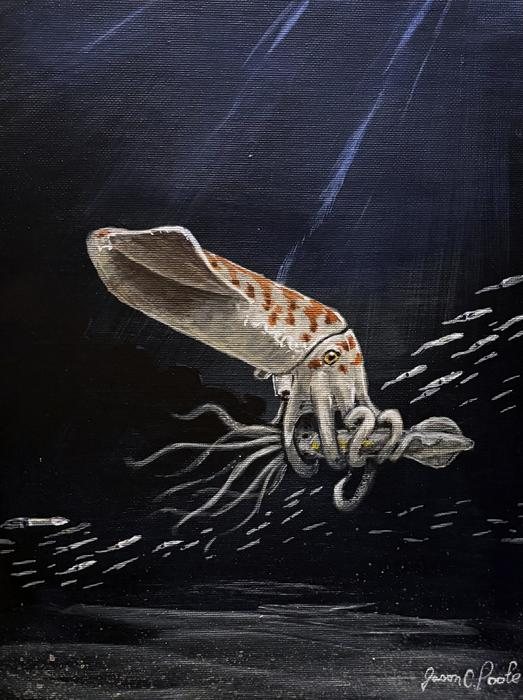
But right now, it is still a hypothesis.
With only two known fossils, nobody has caught Wyoteuthis red-handed eating another belemnite.
What paleontologists can say with confidence is already strange enough: around 160 million years ago, a rare survivor from an ancient belemnite lineage was swimming through the Sundance Sea carrying one of the broadest rostra yet known from the entire group.
Wyoming later fossilized the evidence.
And then called it a squid butt.
Sources
-
‘The big chunky belemnite’: a new relict megateuthidid from the Oxfordian (Late Jurassic) of Wyoming, USA, and its place in the evolutionary history of the group
Ippolitov, A. P., Lippincott, J. L., Wahl, W. R., & Lomax, D. R. (2026). ‘The big chunky belemnite’: a new relict megateuthidid from the Oxfordian (Late Jurassic) of Wyoming, USA, and its place in the evolutionary history of the group. Papers in Palaeontology, 12(5), e70123.
Why this source matters: Primary research paper describing Wyoteuthis linsterorum. Supports the measurements of the two known rostra, CT and micro-CT examination, taxonomic placement within Megateuthididae, and the conclusion that the species represents a relict branch of a lineage otherwise largely lost earlier in the Jurassic.
-
“Peculiar” new species of Jurassic squid found in Wyoming
The University of Manchester. (2026, September 10). “Peculiar” new species of Jurassic squid found in Wyoming.
Why this source matters: Institutional summary of the primary study. Provides accessible context for the two fossil discoveries, the comparison with ordinary Wyoming belemnite rostra, the estimated total animal length of about 60 centimeters, the CT-based interpretation, and Jessica Lippincott’s confirmation that Wyoming paleontologists informally call belemnite rostra “squid butts.”
-
The palaeobiology of belemnites – foundation for the interpretation of rostrum geochemistry
Hoffmann, R., & Stevens, K. (2020). The palaeobiology of belemnites – foundation for the interpretation of rostrum geochemistry. Biological Reviews, 95, 94–123.
Why this source matters: Comprehensive peer-reviewed review of belemnite anatomy and biology. Supports the description of belemnites as extinct squid-like coleoid cephalopods with internal shells, mineralized rostra, ten approximately equal-length arms armed with hooks, and a predatory lifestyle. It also provides context for what paleontologists can and cannot confidently reconstruct from fossilized hard parts.