
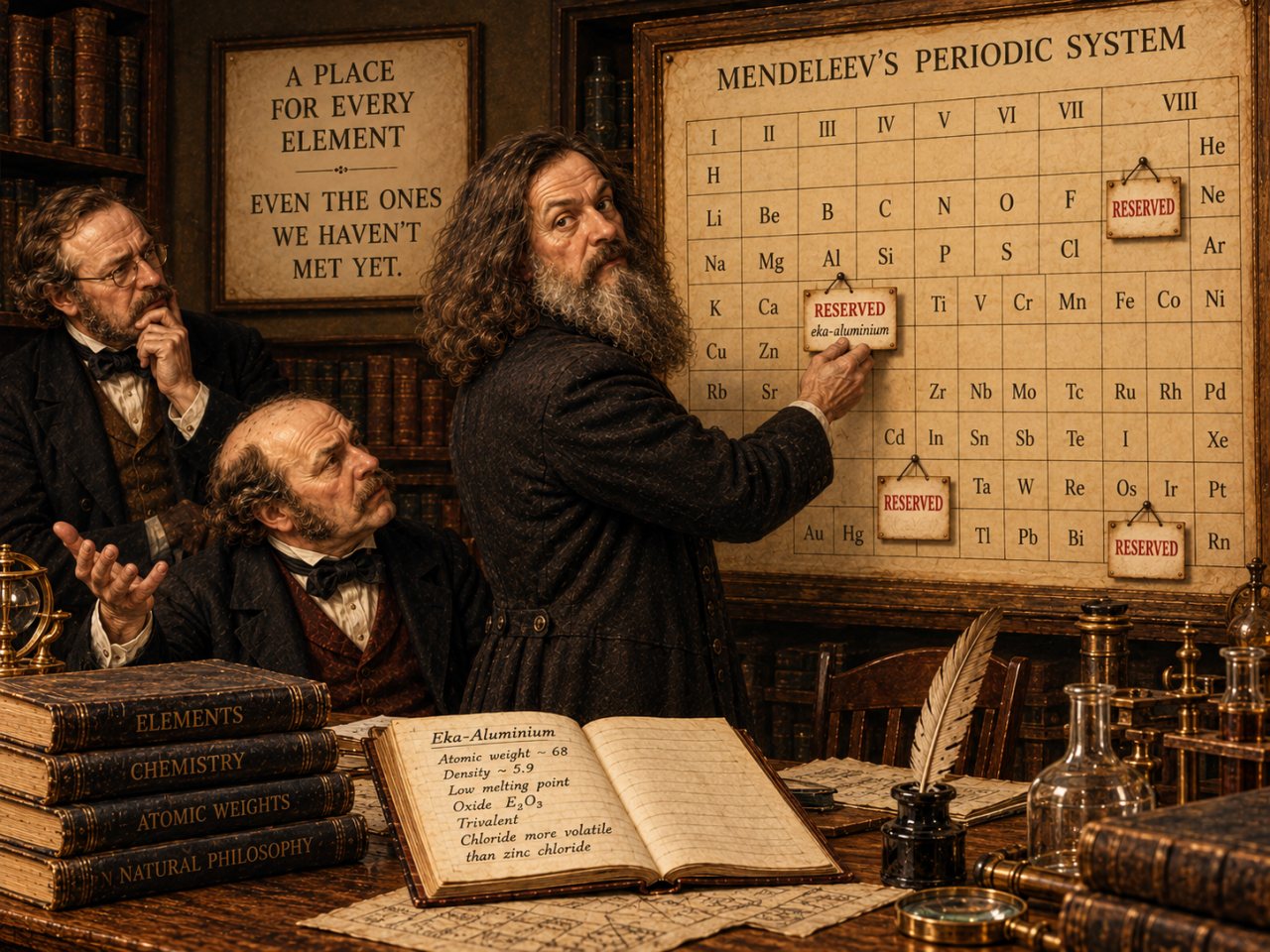
I know, I know... the mere thought of chemistry and the periodic table is making some of you start to cross your eyes and walk away. But stick with me on this one, because this Mendeleev guy was amazingly brilliant.
Dmitri Mendeleev was a Russian chemist who decided to figuratively clean up the chemical drawer. Up to that point, chemists had been collecting and describing a confusing assortment of elements.
Several other chemists were also trying to determine patterns among the elements, but Mendeleev decided to use atomic weight and chemical properties to organize the known elements.
So he created a "periodic table," albeit not the one we currently use today, by arranging elements according to their atomic weights and recurring chemical properties. "Periodic" itself refers to the repetition of specific patterns.
And then Mendeleev took his research one extraordinary step further.
His periodic system revealed GAPS - places where elements SHOULD exist but that had not yet been found.
Mendeleev: “There should be an element here.”
Chemistry: “There isn't.”
Mendeleev: “Not yet. But there will be.”
But he didn't just predict the spaces themselves. He made remarkably specific predictions about the atomic mass, density, chemical behavior, and compounds of elements that should eventually go into those spaces.
And he was right!
Three of his most famous predicted elements were later discovered and turned out to have properties remarkably close to those he had described without ever seeing them: gallium, scandium, and germanium.
And now here's the really amazing part...
Mendeleev did all of this BEFORE scientists had discovered the subatomic machinery that would eventually explain the patterns he was seeing.
He didn't know about electrons.
He didn't know about protons or neutrons.
He didn't know about the atomic nucleus.
He didn't know about electron shells.
He didn't even have atomic numbers.
Mendeleev recognized the PATTERN before science had discovered the underlying machinery producing it. 😳
His original periodic table looks very different from the modern one, and later discoveries would reveal why those repeating chemical patterns exist. But Mendeleev's periodic system helped establish the framework from which the modern periodic table developed.
And just in case predicting undiscovered elements wasn't enough for chemistry immortality, scientists eventually named one after him:
Mendelevium (Md), element 101.
The Real Story
Dmitri Mendeleev was not the first chemist to suspect that the elements followed some kind of order. Throughout the 19th century, scientists including Johann Döbereiner, Alexandre-Émile Béguyer de Chancourtois, John Newlands, William Odling, and Julius Lothar Meyer had identified relationships among elements or proposed ways of organizing them.
What Mendeleev did extraordinarily well was take those repeating patterns seriously enough to make them predictive.
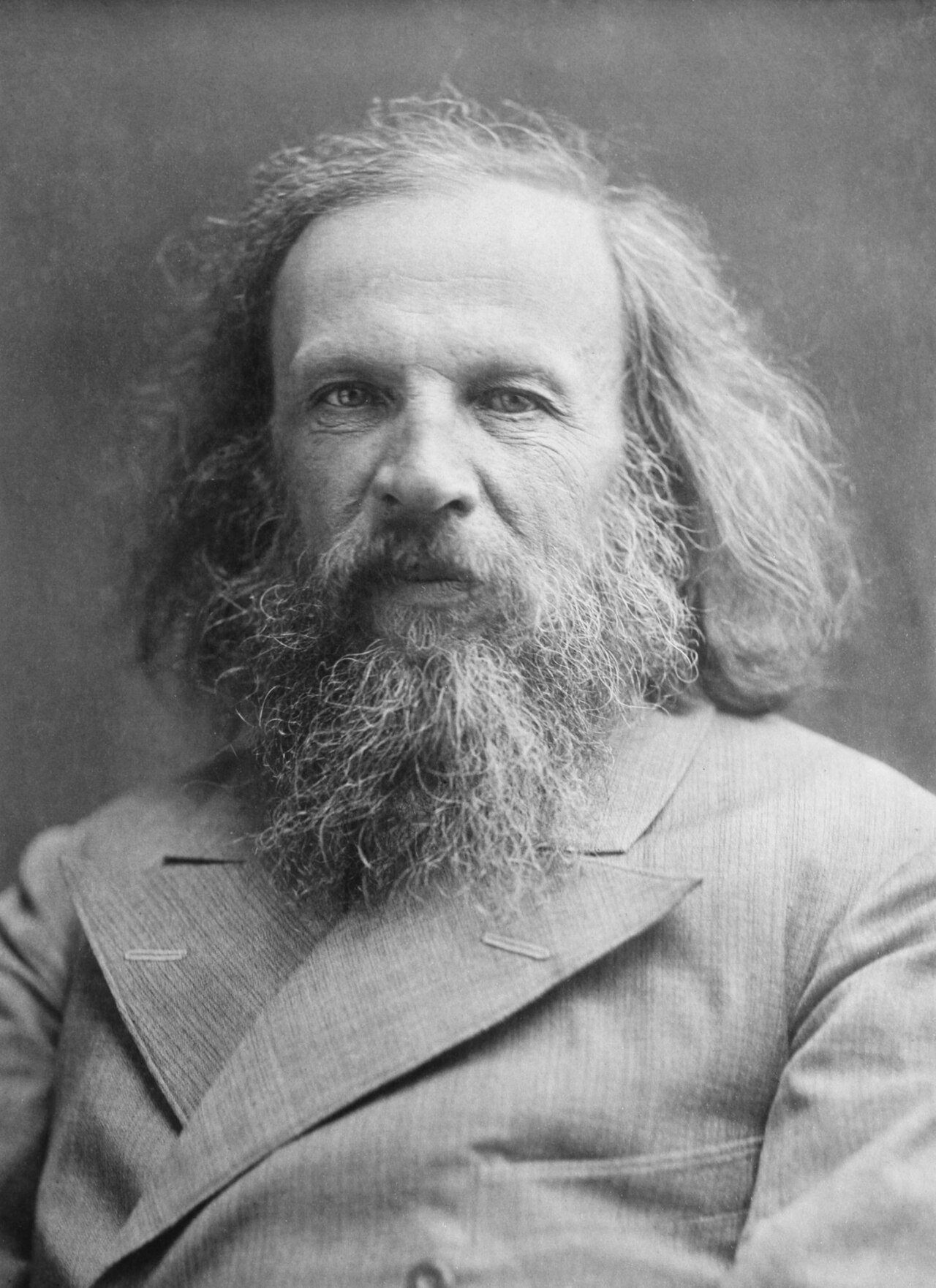
In 1869, Mendeleev arranged the known elements largely according to increasing atomic weight, a measure chemists used to compare the relative masses of atoms, while also grouping elements that displayed similar chemical properties.
Those chemical properties included how an element reacted with other substances and what kinds of compounds it formed. Today, we know why many of those behaviors repeat across the periodic table, but Mendeleev didn't have that knowledge when he was searching for patterns.
Atoms contain a nucleus made of protons and neutrons, surrounded by electrons. The number of protons determines which element an atom is, while the arrangement of its electrons, particularly its outer electrons, strongly influences how it bonds and reacts with other atoms.
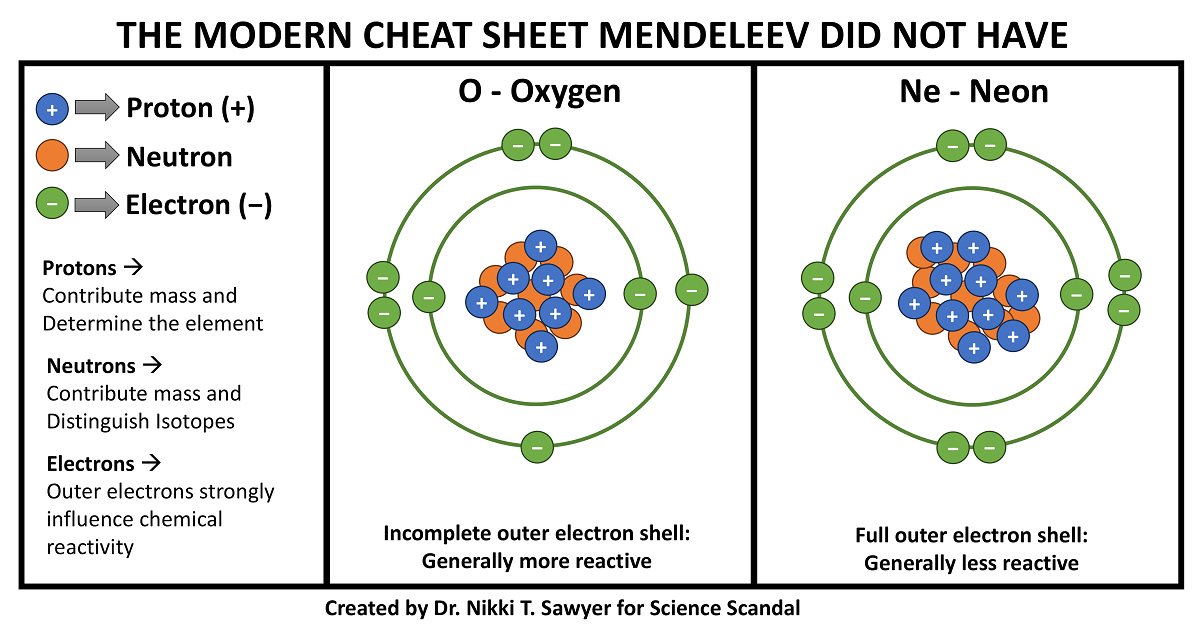
And here's the extraordinary part:
Mendeleev knew none of this.
When he developed his periodic system, scientists had not yet discovered electrons, protons, neutrons, or the atomic nucleus. They didn't know about electron shells, and they didn't have the atomic number as the fundamental way of organizing the elements.
Mendeleev could see the effects of atomic structure in the recurring behavior of the elements, but he could not see the subatomic machinery producing those patterns.
The Gaps Were a Feature, Not a Bug
As Mendeleev arranged the elements into his new table, the pattern sometimes demanded an element exist where no element was currently known.
Rather than squeezing something inappropriate into the space or deciding his system had failed, he left gaps.
By 1871, his periodic system openly contained spaces for elements that chemistry had not yet discovered.
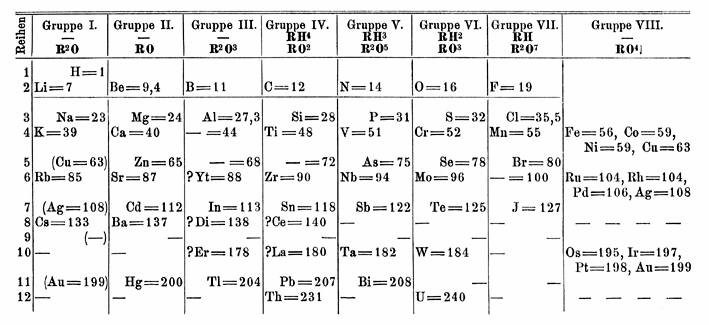
And he didn't stop at saying, “Something probably goes here.”
Mendeleev used the properties of surrounding elements to predict what some of those missing elements should be like. He gave them provisional names such as eka-boron, eka-aluminium, and eka-silicon, using the Sanskrit eka, meaning “one,” to describe their positions relative to known elements.
His predictions included properties that future chemists could actually measure: approximate atomic weight, density, chemical behavior, and the formulas and characteristics of compounds the unknown elements should form.
Then the Missing Elements Started Showing Up
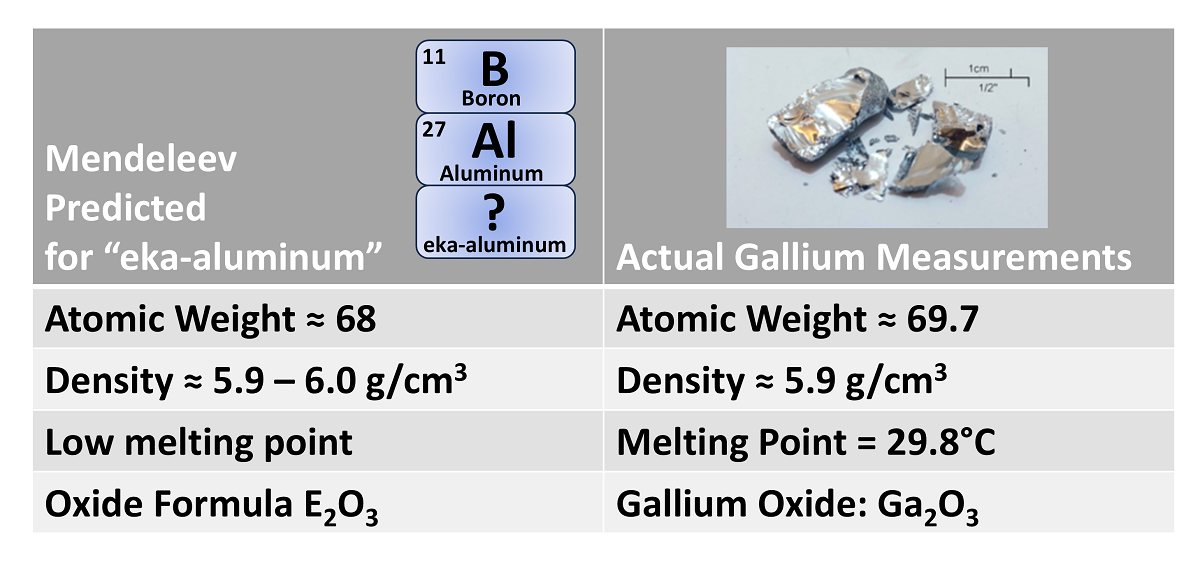
In 1875, French chemist Paul-Émile Lecoq de Boisbaudran discovered gallium. Its properties were remarkably similar to those Mendeleev had predicted for eka-aluminium.
Mendeleev had predicted an atomic weight of about 68; gallium's is about 69.7. He predicted a density near 5.9–6.0 g/cm³; gallium's density is about 5.9 g/cm³. He also correctly anticipated important features of its chemical behavior and compounds.
There was even a wonderfully audacious episode when Lecoq de Boisbaudran initially reported a gallium density that did not match Mendeleev's prediction. Mendeleev, who had never handled the newly discovered element, suggested that the experimental measurement was wrong.
After the gallium was further purified and measured again, the new value was much closer to Mendeleev's prediction!
🤣
Then it happened again.
In 1879, Lars Fredrik Nilson discovered scandium, corresponding closely to Mendeleev's predicted eka-boron.
And in 1886, Clemens Winkler discovered germanium, which closely matched the predicted properties of eka-silicon.
Three of Mendeleev's most famous empty spaces now had occupants.
The Explanation Arrived Later
The discoveries that eventually explained Mendeleev's pattern came afterward.
The electron was identified as a constituent of atoms in 1897. Ernest Rutherford's work revealed the atomic nucleus in 1911. Henry Moseley's experiments in 1913 established atomic number as the fundamental ordering principle behind the periodic table. Rutherford's later work identified the proton, and James Chadwick discovered the neutron in 1932.
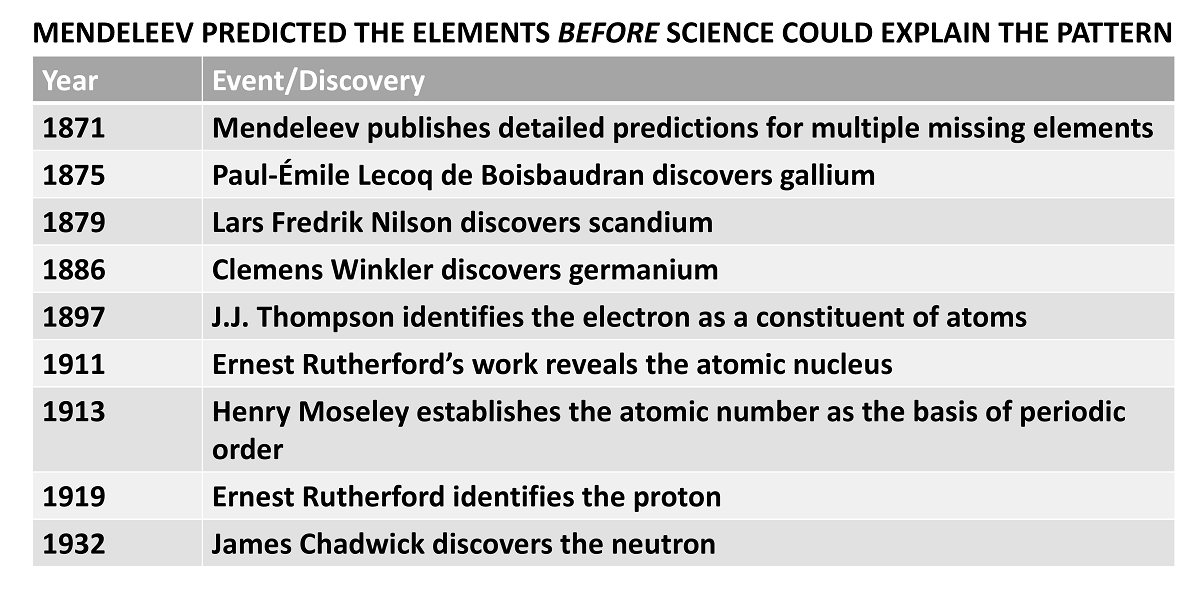
Those discoveries transformed our understanding of why the periodic table works. The modern table is organized by atomic number, not atomic weight, and electron structure explains much of the repeating chemical behavior that Mendeleev could only observe.
Mendeleev had recognized the pattern before scientists knew what was causing it.
His original tables look very different from the periodic table hanging in classrooms today, but his periodic system helped establish something enormously powerful: the table wasn't merely a convenient way to organize known elements.
It could predict chemistry that had not been discovered yet.
And in 1955, scientists at the University of California, Berkeley produced element 101.
They named it mendelevium (Md) in honor of the chemist who had spent his career confidently saving spaces for elements nobody had found yet.
Chemistry eventually saved one for him. 🧪
Sources
-
Development of the periodic table
Royal Society of Chemistry. Development of the periodic table.
Why this source matters: This is the primary umbrella source for the historical development of periodic classification. It documents work preceding Mendeleev by de Chancourtois, Newlands, Meyer, and others; Mendeleev's 1869 periodic system; his organization by atomic weight and chemical properties; his willingness to leave gaps; the correspondence of eka-aluminium with gallium; and Moseley's later establishment of atomic number as the correct ordering principle. It explicitly emphasizes that Mendeleev developed his system before the subatomic basis of periodicity was known.
-
The periodic tables of Mendeleev
Laing, M. (2007, February 28). The periodic tables of Mendeleev. RSC Education, Royal Society of Chemistry.
Why this source matters: Provides detailed historical context for Mendeleev's 1869 and 1871 periodic tables and explains how the 1871 version developed into a substantially more mature periodic system. It specifically documents the gaps for predicted elements with atomic weights 44, 68, and 72, which became scandium, gallium, and germanium, and explains how Mendeleev reorganized the elements according to recurring chemical relationships. It also reinforces an important point in the article: Mendeleev's historical tables differed substantially from the modern periodic table.
-
October 1897: The Discovery of the Electron
Chodos, A. (2000, October 1). October 1897: The discovery of the electron. APS News, American Physical Society.
Why this source matters: Supports the chronology behind one of the article's central revelations: J. J. Thomson's 1897 experiments established cathode rays as negatively charged particles that were constituents of atoms, decades after Mendeleev's 1869 periodic system. The source also usefully distinguishes Thomson's discovery from the earlier coining of the word electron.
-
May, 1911: Rutherford and the Discovery of the Atomic Nucleus
Tretkoff, E. (2006, May 1). May, 1911: Rutherford and the Discovery of the Atomic Nucleus. APS News, American Physical Society.
Why this source matters: Supports the 1911 atomic-nucleus milestone and the historical sequence showing how long after Mendeleev's periodic system scientists developed the modern picture of internal atomic structure. It describes Rutherford's interpretation of the scattering experiments as evidence for a tiny, concentrated central region containing the atom's positive charge and most of its mass.
-
May 1932: Chadwick reports the discovery of the neutron
Tretkoff, E. (2007, May 1). May 1932: Chadwick reports the discovery of the neutron. APS News, American Physical Society.
Why this source matters: Supports James Chadwick's 1932 discovery of the neutron and conveniently provides the earlier nuclear chronology as well: Rutherford's discovery of the nucleus in 1911 and observation of the proton in 1919.
-
Mendelevium - Element information, properties and uses
Royal Society of Chemistry. Mendelevium: Element information, properties and uses.
Why this source matters: Supports the article's closing payoff. Element 101, mendelevium (Md), was first produced at Berkeley in 1955 by a team including Albert Ghiorso, Bernard Harvey, Gregory Choppin, Stanley Thompson, and Glenn Seaborg. The RSC page also reproduces the historical rationale for the name: honoring Mendeleev for his pioneering use of the periodic system to predict the chemical properties of undiscovered elements.
-
Mendeleev: the man and his legacy
Gordon, W. (2007, February 28). Mendeleev: the man and his legacy. RSC Education, Royal Society of Chemistry.
Why this source matters: Provides additional historical context for Mendeleev's development of the periodic system and, importantly, documents the gallium-density episode used in THE REAL STORY. After Paul-Émile Lecoq de Boisbaudran discovered gallium, his initial measured density did not agree with Mendeleev's prediction. Mendeleev challenged the measurement; Boisbaudran subsequently purified the gallium further and obtained a density much closer to Mendeleev's predicted value. This source supports the article's particularly striking example of Mendeleev trusting his periodic predictions strongly enough to question an experimental measurement of an element he had never handled.